Bourchier and Louvaine
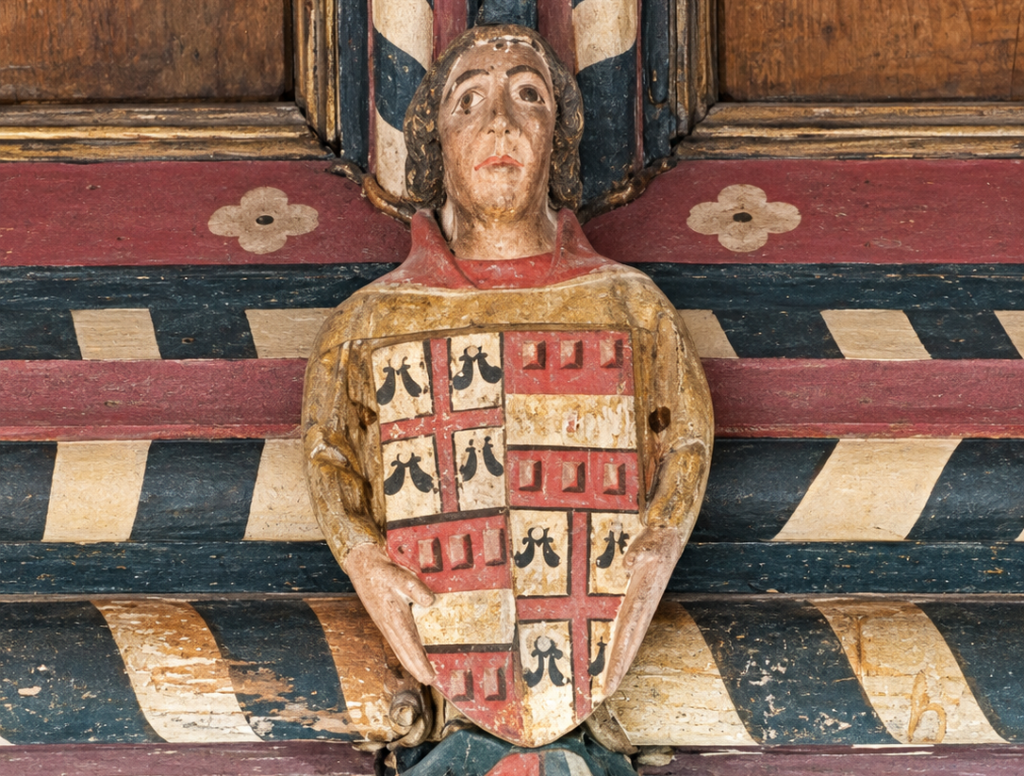
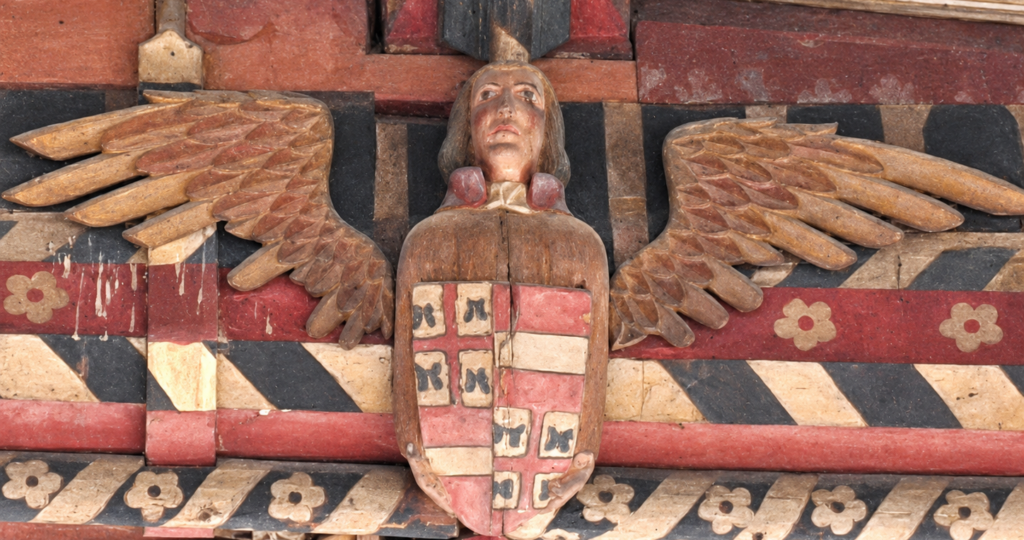
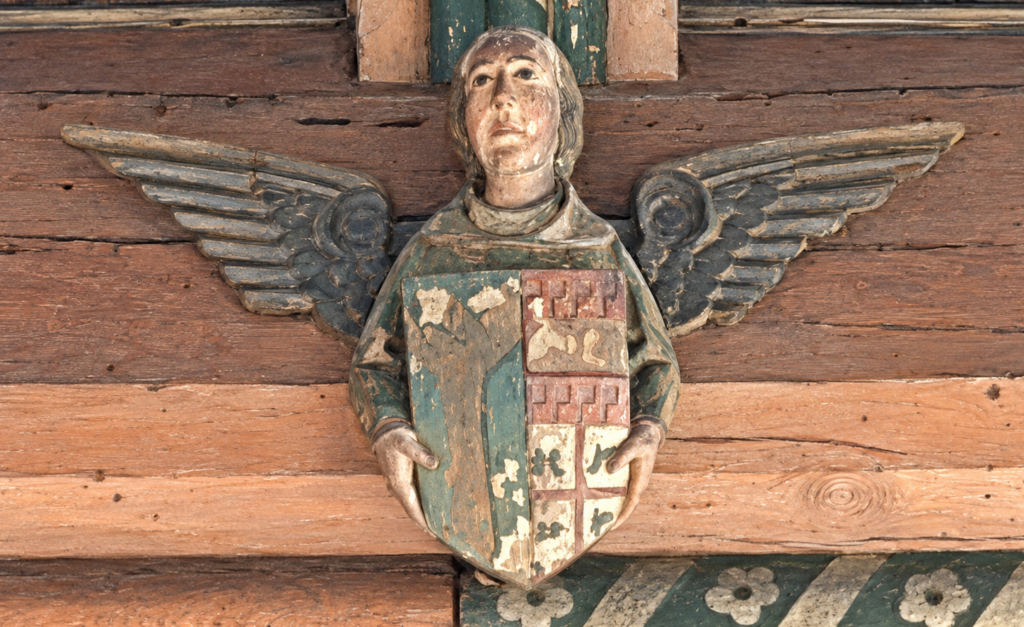
Three figures on the St Thomas’s ceiling carry shields incorporating the arms of Bourchier and Louvaine. The most immediately recognisable feature is the curious black object repeated around the red cross: the water-bouget, a medieval device for carrying water.
The Bourchier arms are Argent, a cross engrailed gules between four water-bougets sable: a red engrailed cross on a silver or white field, with four black water-bougets. The bougets are an example of canting heraldry, a visual play upon the Bourchier name.
The accompanying Louvaine arms are Gules, billety or, a fess argent: a red field scattered with small gold billets and crossed by a silver or white horizontal band. They came into the Bourchier family through Eleanor de Louvaine, heiress of Little Easton in Essex, who married Sir William Bourchier in the fourteenth century. Their descendants continued to display Louvaine alongside Bourchier as an assertion of ancestry.
By the mid-fifteenth century the Bourchiers had become one of England’s most prominent families. Eleanor’s grandson Henry Bourchier became Viscount Bourchier in 1446, a Knight of the Garter in 1452 and later Earl of Essex. His brother Thomas Bourchier became Archbishop of Canterbury in 1454. The family was closely connected by marriage to the royal House of York.
The three St Thomas’s shields therefore fit comfortably into the aristocratic world of the mid-fifteenth century, although they cannot by themselves date the ceiling. Nor has any direct connection between the Bourchiers and Salisbury yet been established.
Why Bourchier/Louvaine appears three times on the ceiling remains an open question. As more of the heraldry is identified, relationships between the families represented may eventually provide the answer.