Arms: Azure, a chevron between three pheons Or.
Plain English: A blue shield bearing a gold chevron between three gold pheons (heraldic arrowheads).

The family
William Swayne was one of the wealthiest and most influential merchants of fifteenth-century Salisbury. His prosperity came principally from the cloth trade, importing dyestuffs and other goods and exporting Salisbury cloth, largely through Southampton.
Swayne served three times as Mayor of Salisbury and also represented the city in Parliament. By 1455 he was one of Salisbury’s largest property owners. His wife, Christian, is named with him in the surviving inscription in the Lady Chapel.
The arms
The Swayne arms are Azure, a chevron between three pheons Or. A pheon is a stylised heraldic arrowhead. RCHME and Buckeridge both identify these arms as Swayne, and the three surviving examples on the ceiling are remarkably consistent.
Salisbury and St Thomas’s
William Swayne had an exceptionally close connection with St Thomas’s. Following the collapse of the chancel in the 1440s, he contributed substantially to the rebuilding of the church and rebuilt St Stephen’s Chapel, now the Lady Chapel, as his chantry chapel.
The chapel ceiling still carries an inscription asking for prayers for the souls of William Swayne and Christian his wife. Swayne also provided a nearby house for his chantry priests. His commercial success, civic prominence and patronage are therefore directly reflected in the surviving fabric and decoration of St Thomas’s.
On the St Thomas’s ceiling
The Swayne arms appear in three places, all in the Lady Chapel:
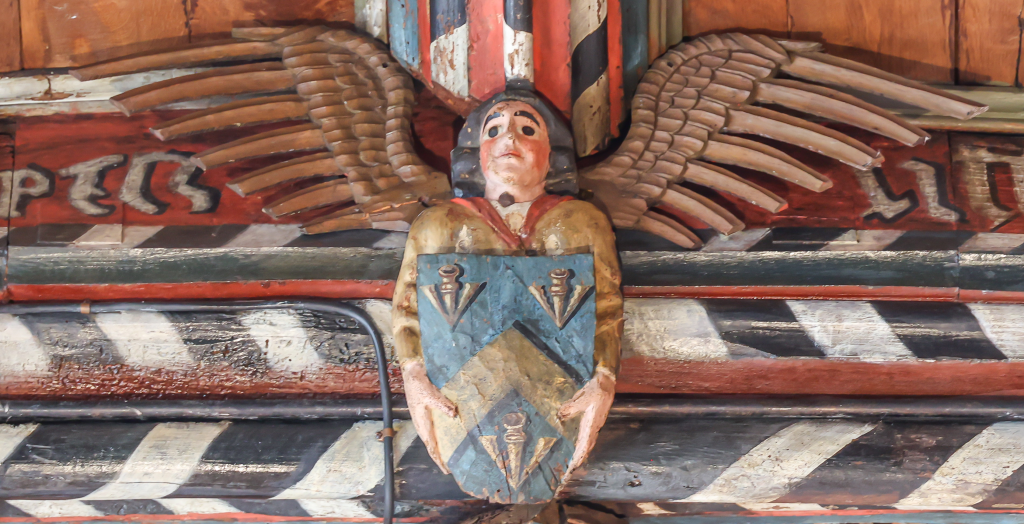
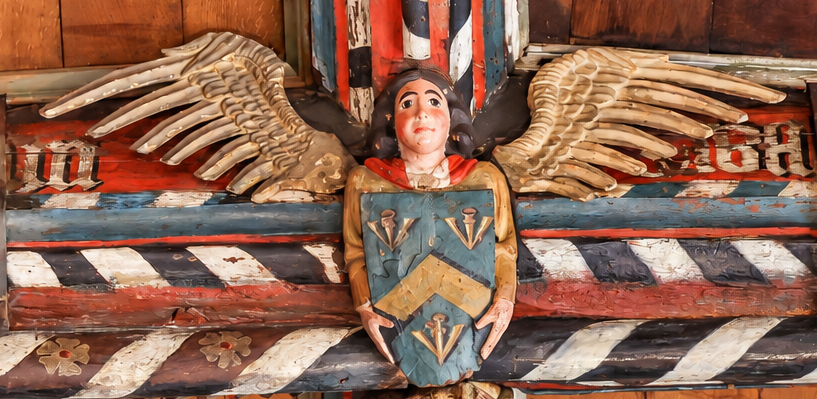
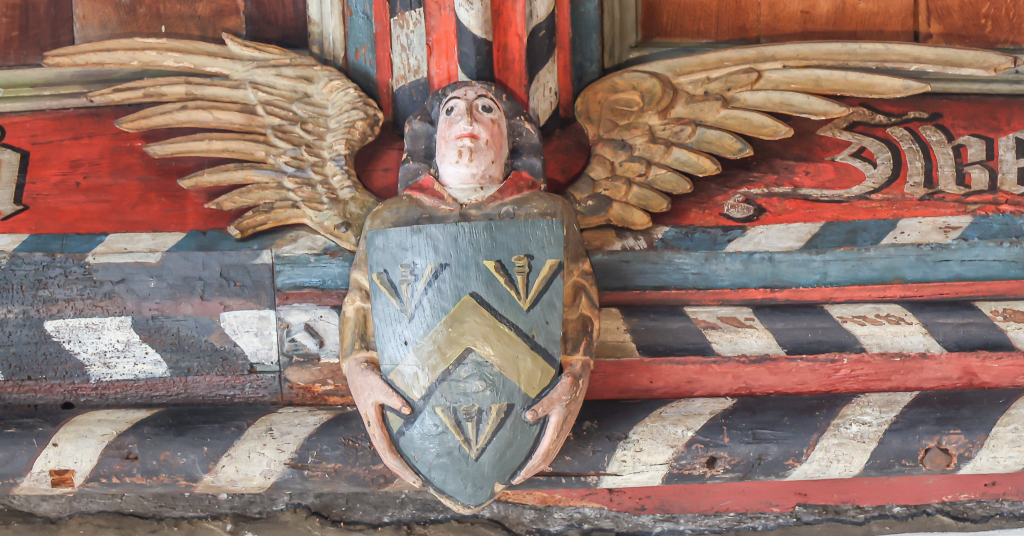
The three shields are very similar, reinforcing the identification and reflecting their place within the same decorative scheme for Swayne’s chapel.
Sources
St Thomas’s Salisbury — church history and Lady Chapel.
John Hare, “Salisbury: The Economy of a Fifteenth-Century Provincial Capital.”
St Thomas’s Salisbury — church history and Lady Chapel.
John Hare, “Salisbury: The Economy of a Fifteenth-Century Provincial Capital.”
RCHME and Buckeridge — identifications of the St Thomas’s ceiling heraldry.