Author: Steve Hoffman

  • The Stourton Family

    Arms: Sable, a bend Or between six fountains proper.

    Plain English: A black shield bearing a gold diagonal band between six heraldic fountains.

    The family

    The Stourtons were an important medieval family whose principal estate was at Stourton on the Wiltshire–Somerset border. Sir John Stourton was created Baron Stourton in 1448, and the family remained prominent in Wiltshire throughout the period in which the St Thomas’s ceiling was created.

    The family also had connections with other important local families through marriage. William Stourton, 2nd Baron Stourton, married Margaret Chidiock, co-heiress of Sir John Chidiock, bringing the Stourtons additional estates and influence in Wiltshire.

    The arms

    The six fountains make the Stourton arms particularly distinctive. A heraldic fountain is represented as a roundel of alternating wavy silver and blue bands, symbolising water.

    The fountains are traditionally associated with the six springs from which the River Stour rises at Stourton. The six fountains were already regarded as characteristic of the Stourton arms in the sixteenth century.

    Salisbury and Wiltshire

    The Stourtons were among the leading landowning families of fifteenth-century Wiltshire. Their elevation to the peerage in 1448 places them firmly within the period represented by the heraldry of the St Thomas’s ceiling.

    On the St Thomas’s ceiling

    The Stourton arms appear at:

    PV1-E

    NA5-S

    SA7-N

    Sources

    History of Parliament — creation of the Barony of Stourton, 1448.

    Arthur Charles Fox-Davies, A Complete Guide to Heraldry — Stourton arms and the tradition of the six fountains.
    ← Return to previous page

  • The Audley/Touchet Families

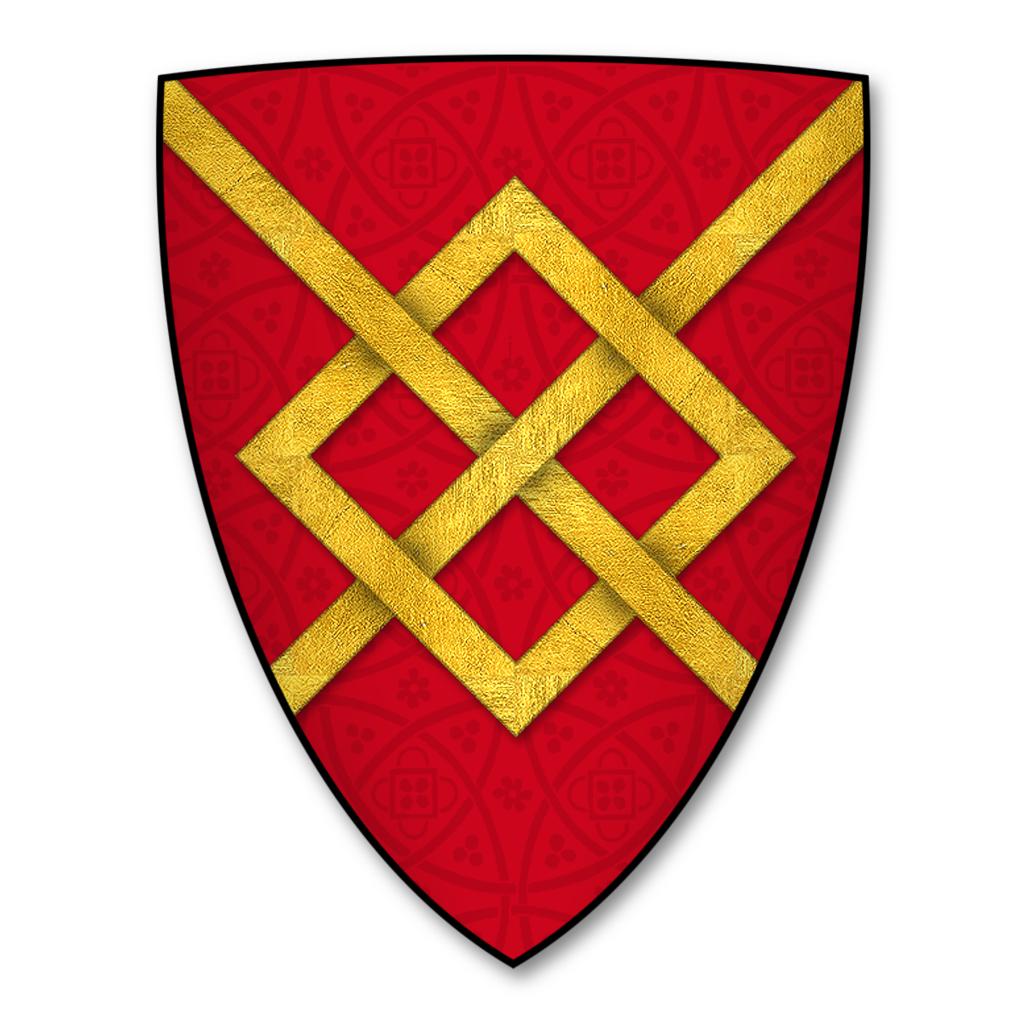
    Arms: Gules, a fret Or.

    Plain English: A red shield bearing a gold interlaced fret.

    The family

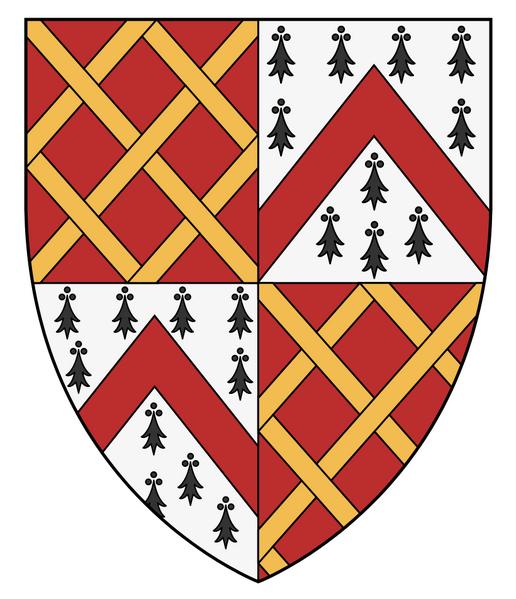
    The medieval Lords Audley descended from the Audley family of Heleigh in Staffordshire. The barony passed through an heiress to the Touchet family, who inherited the title of Baron Audley and combined the arms of the two families.

    During the period of the St Thomas’s ceiling the family was prominent nationally. James Touchet, 5th Baron Audley, was killed fighting for the Lancastrians at the Battle of Blore Heath in 1459. His descendants continued as Barons Audley, although the title was temporarily forfeited after James Touchet, 7th Baron Audley, joined the Cornish rebellion of 1497. It was restored to his son John in 1512.

    The arms

    The original Audley arms are Gules, a fret Or — a gold interlaced fret on a red field.

    The Touchet arms are Ermine, a chevron Gules — an ermine field bearing a red chevron.

    As Barons Audley, the Touchet family used the two coats together, quartering Touchet with Audley. The simple gold fret on red nevertheless continued to represent Audley and was used by Bishop Edmund Audley at Salisbury Cathedral.

    Salisbury and Wiltshire

    The family’s strongest Salisbury connection was Edmund Audley, a younger son of James Touchet, 5th Baron Audley.

    Edmund became Bishop of Salisbury in 1502 and remained bishop until his death in 1524. He built the richly decorated Audley Chapel on the north side of the choir in Salisbury Cathedral as his chantry chapel and was buried there.

    The Audley fret is repeated extensively in the decoration of the chapel and can still be seen there today. It therefore provides particularly strong surviving evidence for the use of the Audley arms in Salisbury during the period of the St Thomas’s ceiling.

    On the St Thomas’s ceiling

    The Audley arms appear in four places:

    SA3-W

    PV2-E

    NA6-N

    SA6-E

    The distinctive interlaced fret makes the heraldic identification strong. Its presence does not necessarily identify Bishop Edmund Audley personally, but his position as Bishop of Salisbury from 1502 to 1524, and the repeated use of the Audley fret in his surviving chantry chapel in Salisbury Cathedral, provide a particularly close contemporary connection between the Audley family and Salisbury.

    Sources

    The History and Antiquities of the Cathedral Church of Salisbury — Edmund Audley and his chantry chapel.

    The Complete Peerage / Cracroft’s Peerage — descent of the Barony of Audley and the Touchet and Audley arms.

    Salisbury Cathedral — the surviving Audley Chapel.

    ← Return to previous page