Enhanced image
Description
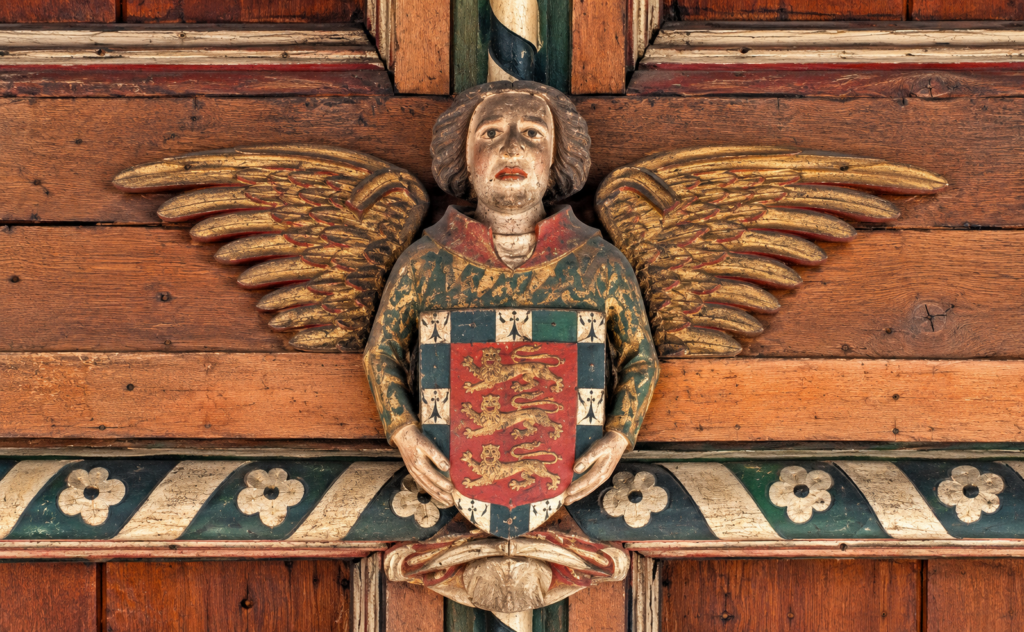
A carved and painted angel with outspread wings holds a heraldic shield against the timber roof of the north aisle. The figure is frontal, with the shield occupying most of the lower body. The shield has a red central field bearing three gold lions arranged vertically, surrounded by a broad border divided into alternating dark blue-green and white compartments. The white compartments carry black ermine-like marks. The figure and surrounding timbers retain extensive traces of medieval polychromy and gilding.
Heraldry
Blazon: Gules, three lions passant guardant in pale Or, within a bordure compony Azure and Ermine (tinctures and details of the bordure provisional).
Plain English: On a red field are three gold lions, one above another, walking with one forepaw raised and their faces turned towards the viewer. Around the shield is a border divided into alternating blue and ermine-patterned sections.
A bordure added to the plain royal arms of England is the standard medieval way of marking a cadet or illegitimate branch of the royal family — and this specific combination, a bordure compony of argent and ermine, is documented as the arms of Thomas Beaufort, 1st Duke of Exeter (c.1377–1426), third son of John of Gaunt by his mistress (later wife) Katherine Swynford, and thus a member of the famous Beaufort family — the illegitimate but subsequently legitimised line of the House of Plantagenet from which the Tudor dynasty (via Margaret Beaufort, mother of Henry VII) ultimately descended.
The wider Beaufort siblings — John Beaufort, Earl and later Marquess of Somerset; Henry Beaufort, Bishop of Lincoln and Winchester and later Cardinal; Thomas Beaufort, Duke of Exeter; and Joan Beaufort, Countess of Westmorland — all used variants of “England, within a bordure compony” as their shared family mark, so this could represent the Beaufort family more generally rather than Thomas specifically. It’s an exceptionally high-status coat to find in a parish church roof, and given the Beauforts’ vast landholdings and political reach across southern England in the early-to-mid 15th century — precisely the period this ceiling was painted.
Identification: RCHME: Gules three lions passant or, within a border azure semy of crosses paty argent; Buckeridge: Gules, three lions passant guardant in pale or, within a bordure sable entire crosses pattee argent.
Condition
The carving is substantially intact, but the painted surface is worn and uneven. There is widespread abrasion and loss of pigment and gilding, with particular uncertainty in the details and original colours of the bordure. The central red field and the three lions remain legible enough for the principal heraldic device to be recognised. Any reconstruction of the border should therefore be treated as provisional pending closer examination of the original surface or conservation records.